minutes · September 10, 2026
Keeping the Minutes at Larkin Court
A small residents' association in an invented city learns that a good record outlasts a good argument. How a plain notebook, a fixed format and one rule about initials keep a group honest.
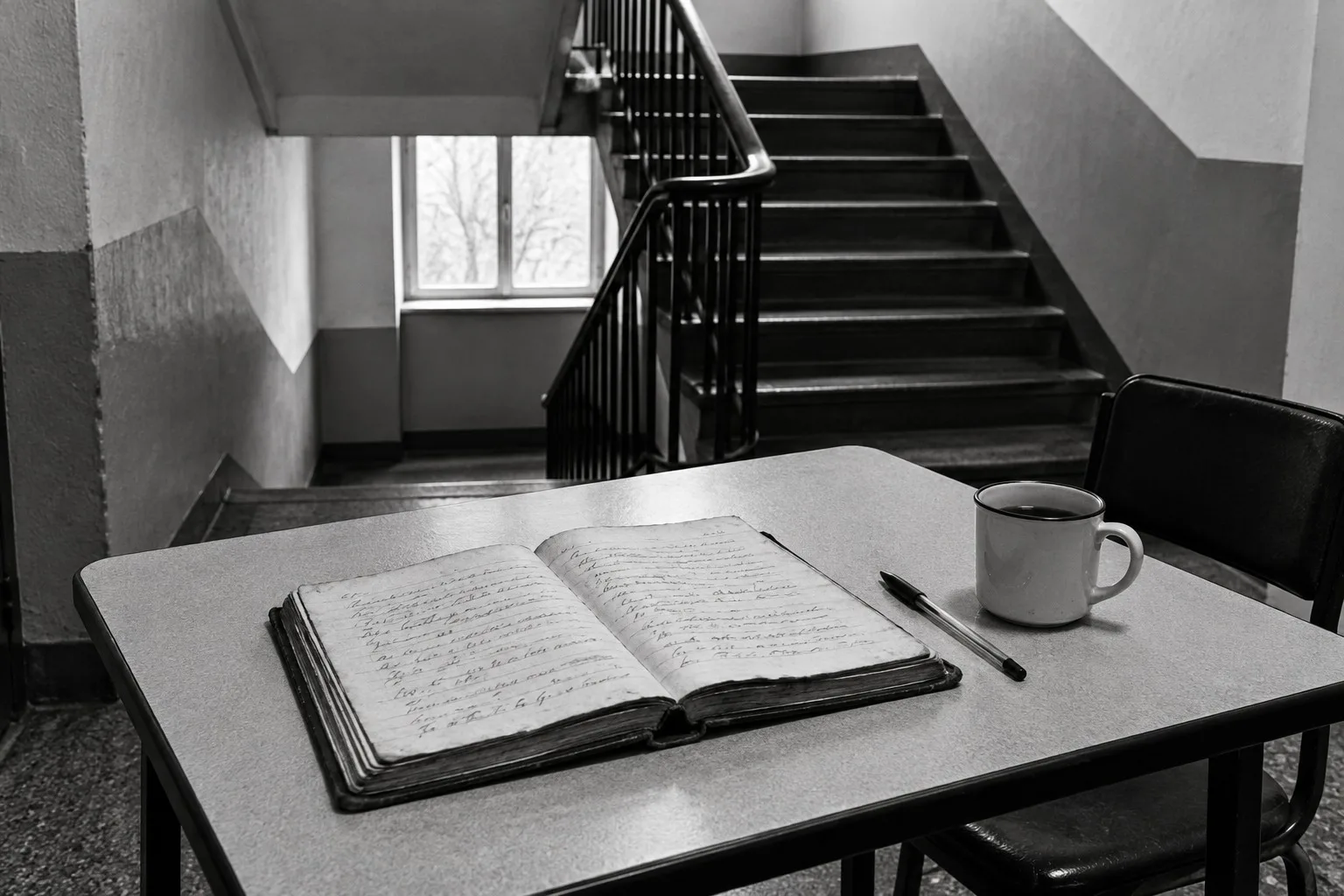
Larkin Court is a block of thirty-two flats in Ostmere, and its residents' association has kept one notebook for six years. It is a red hardback with a cracked spine. It is the most valuable object in the building, and nobody has ever tried to steal it.
We asked how they do it. The answer was almost embarrassing in its plainness.
One notebook, never loose sheets
Loose sheets get lost. They get used as coasters. They end up in a drawer in somebody's kitchen and surface at a funeral. The notebook lives in a labelled box in the entrance hall, and it never leaves the building.
Each entry starts on a new page with a date at the top and a list of who attended. That's it. Fourteen words of structure, and every page after that is findable.
The format doesn't change
Every meeting follows the same four headings: Present, Discussed, Decided, To do. Nobody has to think about it. A new secretary opens the book, reads the last page and copies the shape.
The value of a fixed format is that gaps become obvious. If the Decided heading is blank, nobody pretended a decision was made. If the To do heading has no names, everybody can see the thing is orphaned.
A record is a promise you make to the person who will be tired next time.
The secretary, Marit, said that one. She wouldn't tell us who she was quoting. We suspect herself.
Initials beside every decision
When something is decided, two people write their initials in the margin. One was in favour. One wasn't, or was only partly. It doesn't matter who. What matters is that two people looked at the line and agreed it said what happened.
This is slow for about a minute and saves months. Nothing makes a later quarrel shorter than a sentence both sides initialled.
Write what was said, not what was meant
Marit has one rule above the rest: write down what was agreed, not what you think they meant. If the room says "the stairwell light will be fixed soon," she writes "stairwell light: agreed to be fixed, no date given." It reads blunt. It is also the line that saves everyone when the light is still out in March.
Read it back
At the end of every meeting the secretary reads the Decided and To do sections aloud. Any correction is made in the book, in the margin, in a different pen, so that the original remains legible. Never rub out. Never tear. Crossed-out words tell their own story.
Why bother? Because memory is a poor clerk. Six people will remember six different meetings, each one flattering to the person remembering. The notebook has no opinion. It records, and in six years it has been wrong only twice, both times on the date.
There is nothing here you can't do tomorrow. A notebook, a pen and the habit of reading it back. Start there.
Names, places and events in this demo are fictional.
No comments yet
Comments are open. Have a thought or a question? Share it below.