libraries · September 17, 2026
An Hour Nobody Owns
A thought experiment about one unprogrammed hour a week in a public library: no event, no target, no agenda. What a building does when it is simply allowed to be open.
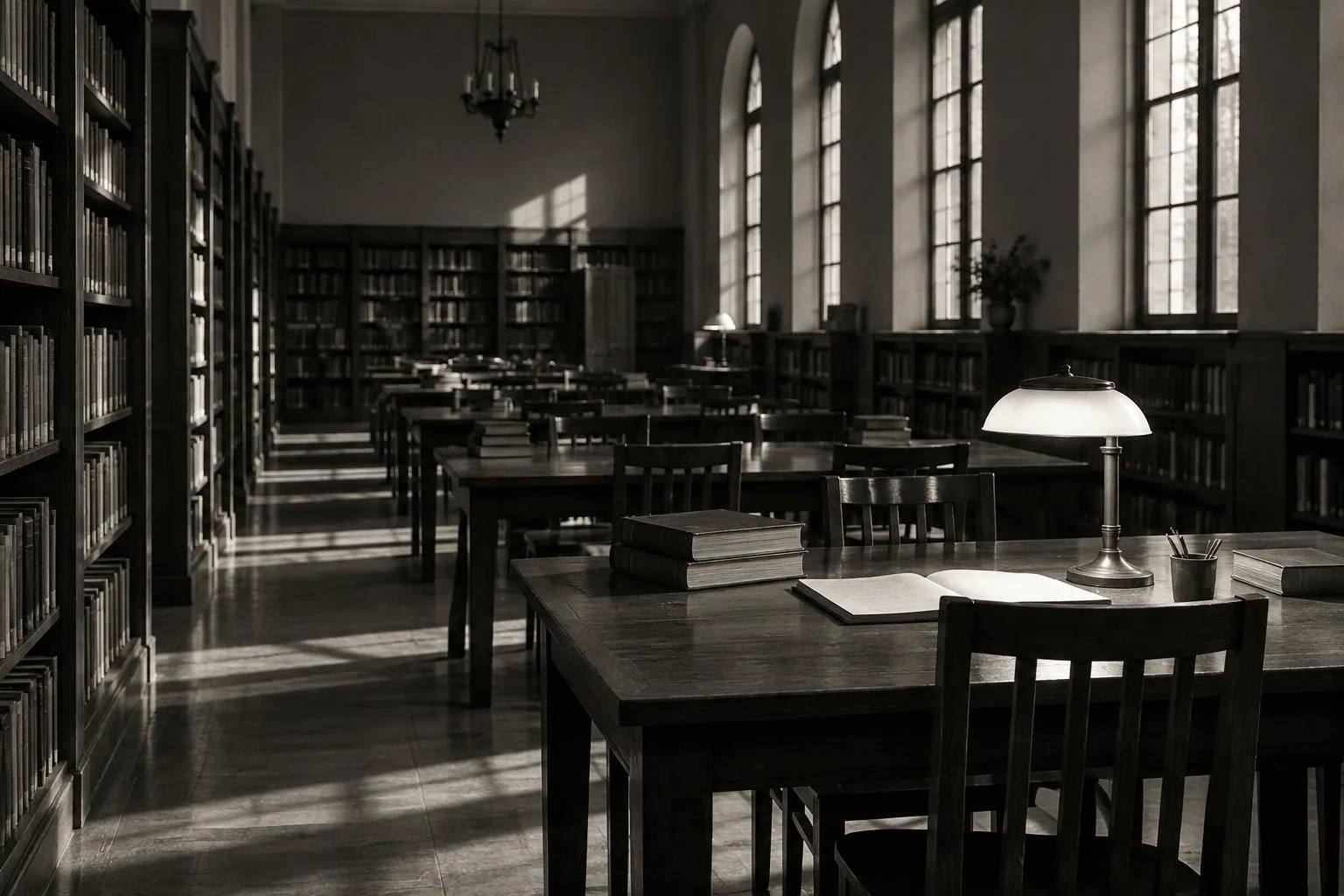
Imagine a library with one rule for one hour a week: nothing happens.
No story time. No workshop. No exhibition, no survey, no table of leaflets about the next table of leaflets. The doors are open, the lights are on and the staff do the quiet jobs they never get round to. That is all.
This is not a proposal. It is a thought experiment, and we'd like to run it in your head.
What the hour is for
Most public buildings are scheduled into the ground. Every hour carries a purpose, because a purpose can be counted, and what can be counted can be defended at a budget meeting. That makes a certain kind of sense. It also means that nothing in the building is allowed to be merely available.
An unprogrammed hour is an argument for the opposite: that a room is sometimes best when it asks nothing of you.
Who turns up
Imagine the first week. Four people. A student who has run out of places that are warm. A man who reads the same newspaper he'd read at home, but in better company. A child sent in with a coin and told to be quiet. A woman who has a form to fill in and cannot do it at the kitchen table.
None of them came for an event. Each of them came because the door was open and the hour had no price.
The argument against
The sceptic says: you cannot measure it. What will you write in the annual report? Four visitors, no outputs?
And the answer is: yes. Exactly that. Some things only exist if you stop measuring them. An hour whose success is the absence of a target is a stubborn little idea, and it deserves to be kept stubborn.
The design of an empty hour
Even nothing needs a design. Keep the main room, not the side room. Leave the chairs where people left them. Turn the radio off. Put one lamp on that is not strictly necessary.
The staff should be visibly doing something quiet, shelving, repairing a spine, because a person at work is a kind of permission. Visitors can settle in. Nobody has to ask what they're allowed to do.
A library is the last building that agrees with you before you've said anything.
We copied that into the front of our own notebook, and nobody can remember where it came from.
What we are not saying
We are not saying a town must do this. We aren't asking you to sign anything, or to write to anyone, or to be angry about anything. This is a design idea about time and rooms. Take it or leave it at the door.
But the next time you walk past a building with its lights on and nothing scheduled, stop for a moment. That might be exactly how it's meant to be.
Names, places and events in this demo are fictional.
No comments yet
Comments are open. Have a thought or a question? Share it below.