meetings · August 20, 2026
A Meeting That Ends on Time
Most meetings run long because nobody decided what they were for. Six small moves from the Ostmere zine table that bring a room to a stop at the hour it promised.
We meet on Thursdays. We finish at 7:45. Not 7:50. Not "we'll just wrap up."
This is not a talent. It is a set of habits, and anyone can steal them.
One page, three lines
The agenda fits on a single sheet and has three lines, never more. If it needs a fourth line, it needs a second meeting. We write the agenda before the meeting, on paper, and pin it where everyone can see it. A meeting without a written agenda is a conversation with chairs.
Each line gets a time. Ten minutes. Fifteen. Twenty. The numbers add up to less than the hour, because the first rule of time is that it lies.
A timer, in plain sight
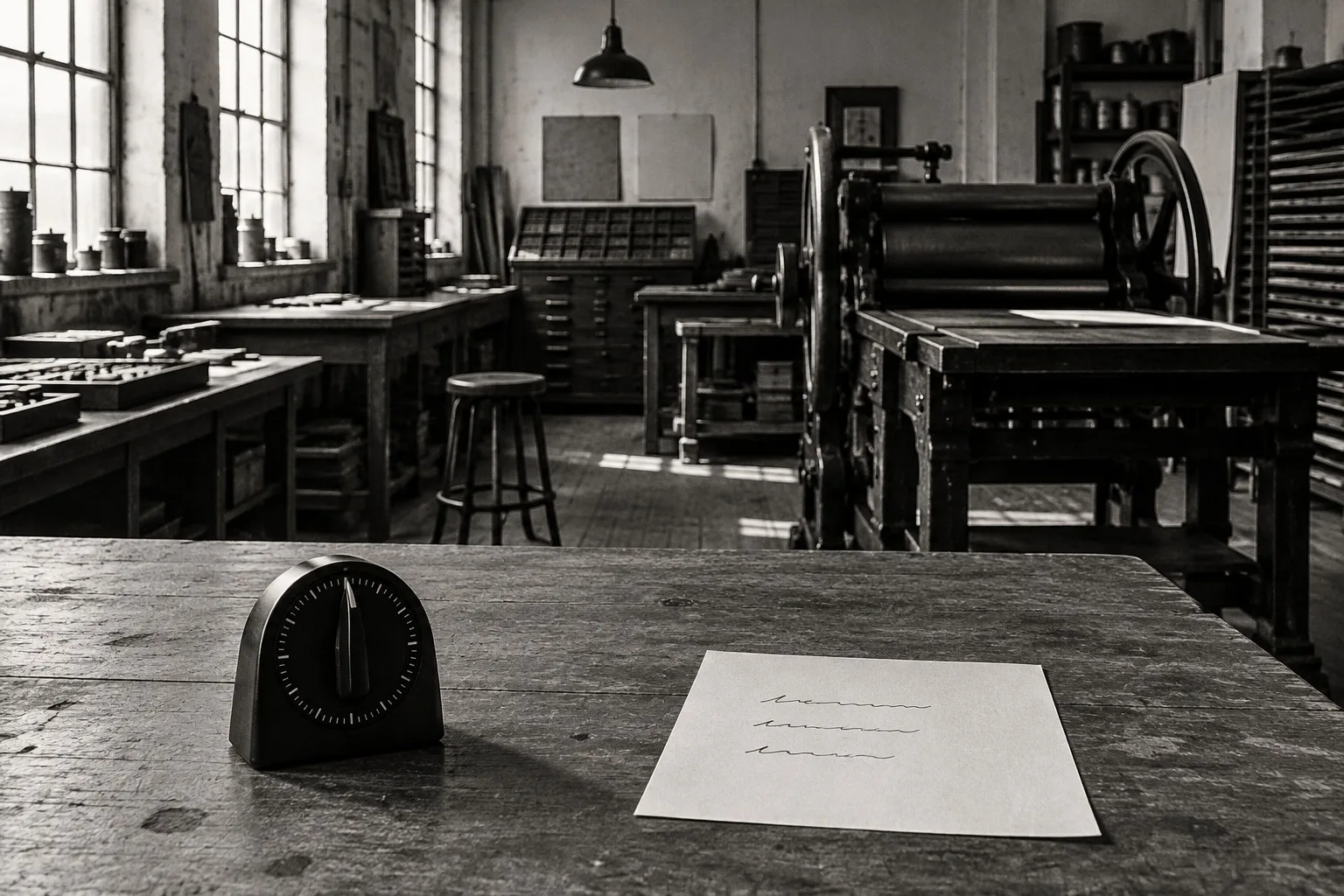
We use a black kitchen timer that ticks. It sits in the middle of the table. When it rings, the speaker finishes the sentence and stops. Nobody apologises. Nobody makes a face.
The timer is the villain so that no person has to be. Once the rule belongs to an object, nobody has to enforce it, and that is the whole trick.
Decisions are one sentence long
Every item ends with a sentence that begins "We will". If you can't write it, the item isn't finished. It goes to the top of the next agenda and the group moves on.
We will print two hundred, in black, by the first of the month.
That's a decision. Who, what, how many, by when. If the sentence has a "maybe" in it, it's a mood.
Names on actions
An action without a name is a wish. We write the first name beside every task and say it out loud: "Dara, the proofs." Dara says yes, or says no, and either answer is fine. Silence is the only answer we don't accept.
One more habit: latecomers join, they don't restart. If you walk in late, you sit down and listen. Nobody summarises for you. The meeting doesn't loop back. Lateness costs the latecomer, not the room, and you'd be surprised how fast that changes behaviour.
Minutes are five lines
One person writes them in the last five minutes while everyone watches. Decisions, actions, next date. Not who said what. Not the jokes. They go on the same sheet, under the agenda, so the paper tells the whole story and nobody needs to remember.
It sounds severe. It isn't. A meeting that ends on time leaves people with an evening, and an evening is a kind of respect.
Try it once. Pin the paper, set the timer, write the sentence. If it works, tell someone else. If it doesn't, change one thing and try again.
Names, places and events in this demo are fictional.
No comments yet
Comments are open. Have a thought or a question? Share it below.